

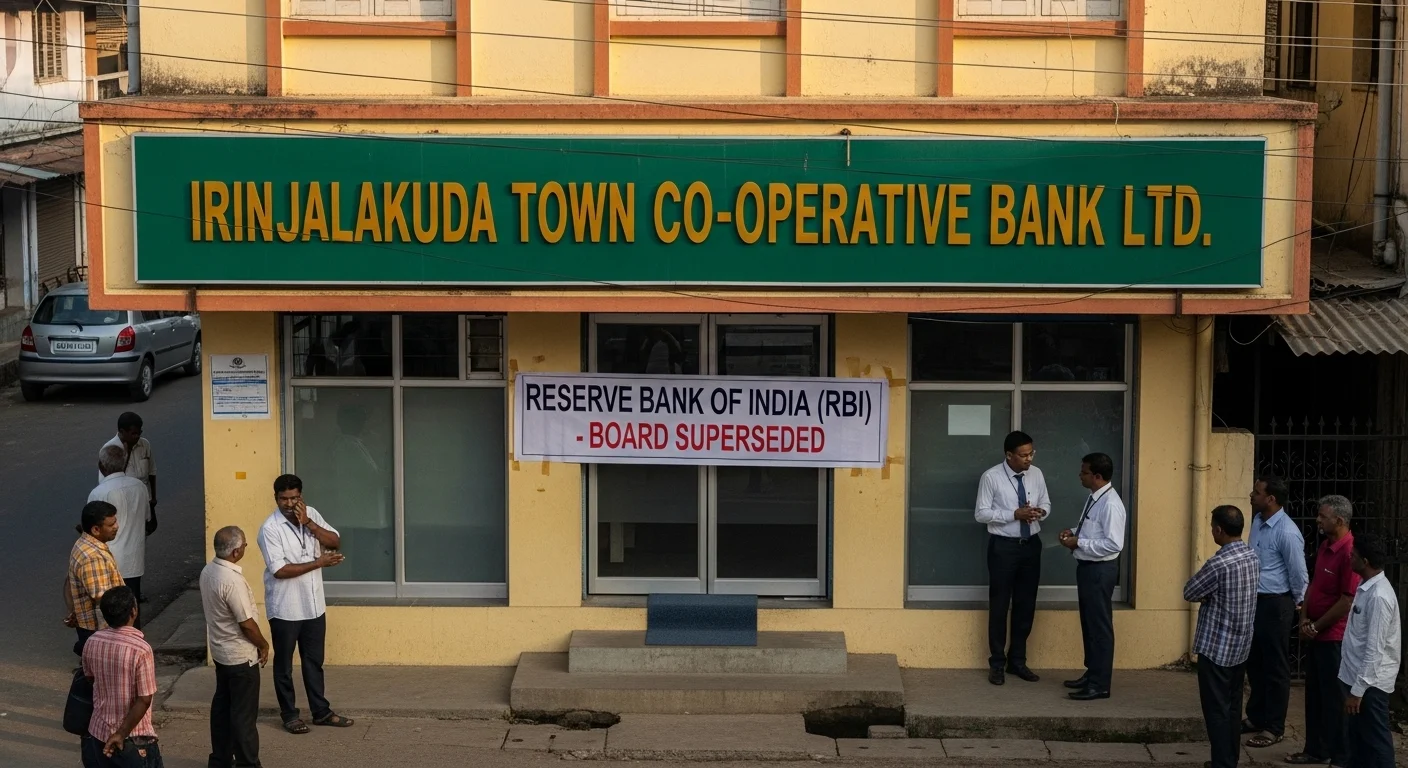
- On October 7, the Reserve Bank of India (RBI) took the significant step of superseding the Board of Directors at Irinjalakuda Town Co-operative Bank Ltd, pointing to serious concerns regarding the bank’s declining financial health and governance issues.
- In light of this decision, the RBI has appointed Raju S.
- Nair, who previously served as Vice President at Federal Bank, to step in as the Administrator and oversee the bank’s operations during this period of transition.
- To assist him, the central bank has also set up a Committee of Advisors, which includes Mohanan K, a former Deputy General Manager at South Indian Bank, and T.A.
- Mohamed Sageer, another former Vice President of Federal Bank, as noted in an RBI release.
On October 7, the Reserve Bank of India (RBI) took the significant step of superseding the Board of Directors at Irinjalakuda Town Co-operative Bank Ltd, pointing to serious concerns regarding the bank’s declining financial health and governance issues.
In light of this decision, the RBI has appointed Raju S. Nair, who previously served as Vice President at Federal Bank, to step in as the Administrator and oversee the bank’s operations during this period of transition.
To assist him, the central bank has also set up a Committee of Advisors, which includes Mohanan K, a former Deputy General Manager at South Indian Bank, and T.A. Mohamed Sageer, another former Vice President of Federal Bank, as noted in an RBI release.
The RBI explained that this action was necessary due to significant concerns arising from the bank’s ongoing poor financial condition and governance standards.
Earlier, on July 30, the RBI had issued specific Directions to Irinjalakuda Town Co-operative Bank Ltd, stating that starting from the close of business on July 30, 2025, the bank would not be allowed to grant or renew any loans or advances, make investments, incur liabilities—including borrowing funds or accepting new deposits—disburse payments, enter into any compromises or arrangements, or sell or transfer any of its properties or assets without prior written approval from the RBI.
Recently, the RBI had been in discussions with the bank’s Board and Senior Management to encourage improvements in its operations. However, due to the bank’s insufficient efforts to address supervisory concerns and the lack of capital infusion to meet minimum regulatory requirements, the RBI felt compelled to issue these directions to safeguard the interests of the bank’s depositors, as stated on July 30.