


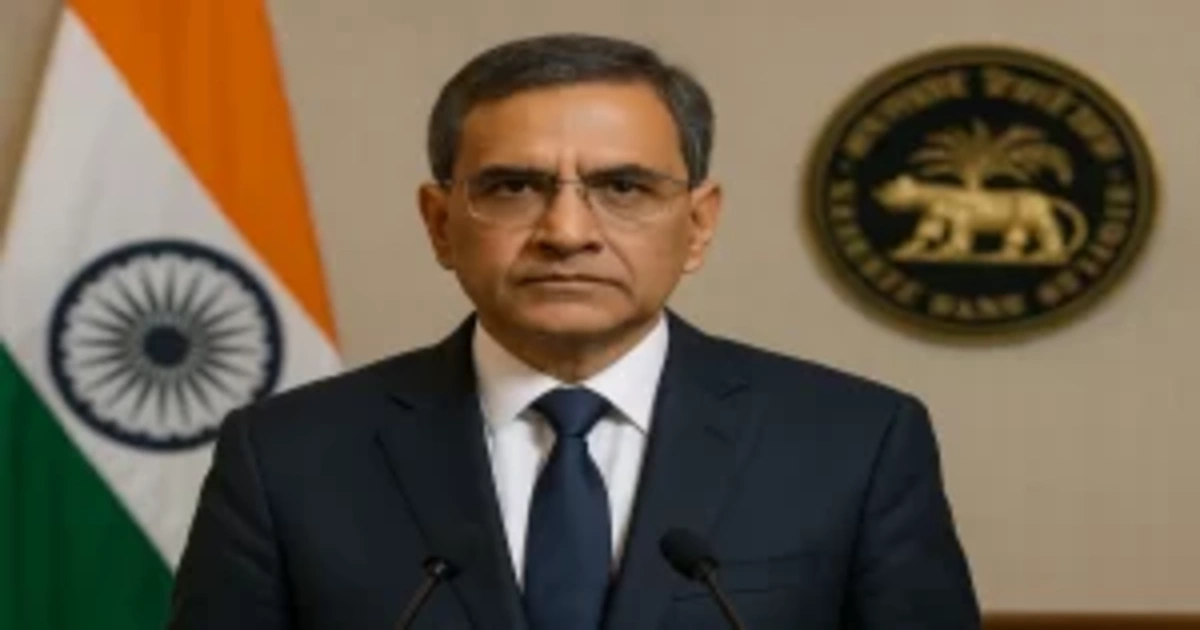
- The Reserve Bank of India (RBI) might think about cutting interest rates further if inflation dips below expectations or if the economy shows signs of slowing down, Governor Sanjay Malhotra shared in an interview with CNBC-TV18 on Tuesday.
- “The monetary policy committee will always take into account the changing circumstances and the outlook before deciding what the economy truly needs,” Malhotra explained.
- He mentioned that a rate cut could be on the table if inflation falls short of predictions or if economic activity starts to wane.
- While he emphasized that maintaining price stability is the RBI’s top priority, Malhotra also pointed out that fostering growth is just as crucial.
- “It’s not accurate to say that inflation is more important than growth; it’s always a balance of both,” he remarked.
The Reserve Bank of India (RBI) might think about cutting interest rates further if inflation dips below expectations or if the economy shows signs of slowing down, Governor Sanjay Malhotra shared in an interview with CNBC-TV18 on Tuesday.
“The monetary policy committee will always take into account the changing circumstances and the outlook before deciding what the economy truly needs,” Malhotra explained. He mentioned that a rate cut could be on the table if inflation falls short of predictions or if economic activity starts to wane.
While he emphasized that maintaining price stability is the RBI’s top priority, Malhotra also pointed out that fostering growth is just as crucial. “It’s not accurate to say that inflation is more important than growth; it’s always a balance of both,” he remarked.
His remarks came just a day after India’s retail inflation hit its lowest point in over six years, mainly due to a drop in food prices. Inflation is now anticipated to fall below the RBI’s previous estimate of 3.7% for the year.
Malhotra reiterated the RBI’s GDP growth forecast of 6.5% for FY26, indicating it aligns with their internal expectations. “The monsoon is looking good, consumer surveys are showing optimism, and trade agreements are in progress,” he noted, while also recognizing the mixed signals coming from the wider economy.
Since February, the central bank has reduced the benchmark repo rate by 100 basis points, including a 50 bps cut during its latest meeting, where it also adopted a more hawkish-neutral approach.
The RBI is dedicated to keeping overnight borrowing costs in line with the benchmark repo rate, which currently stands at 5.5%. “We aim to manage liquidity through absorption or injection as needed,” Malhotra stated.
Review of Bank Ownership Rules
The governor also mentioned that the central bank is looking into its regulations regarding bank ownership, including potential changes to allow foreign strategic investors to increase their stakes in Indian banks.
Right now, foreign investors, like those in portfolio investments, can own up to 74% of private banks, while strategic investors are limited to just 15%. The RBI is thinking about raising that cap to 26%, but it would need regulatory approval first.
Malhotra made it clear that the RBI probably won’t change its stance on letting business conglomerates own banks. He pointed out, “Running a business and engaging in real economic activities within the same group creates a conflict of interest.”
Liquidity Framework Review Coming Up
An internal committee has been looking into the RBI’s liquidity management framework. Malhotra mentioned that a report detailing their findings should be out by the end of July.