

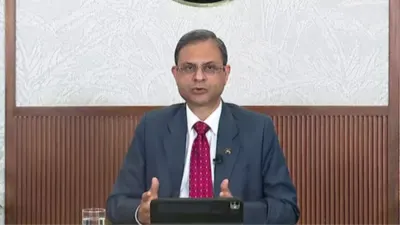
- RBI governor Sanjay Malhotra made it clear on Friday that there’s no plan to let corporations, whether directly or through non-banking financial companies (NBFCs), get banking licenses.
- He pointed out that this would create “an inherent conflict of interest with a group actually dealing with the money of the depositors.” He also mentioned that the monetary policy committee’s neutral stance allows for flexibility in adjusting interest rates—whether that means raising, lowering, or holding steady.
- Malhotra emphasized that future decisions on rates will be “data-driven, focusing more on the outlook,” especially regarding inflation and growth.
- “Inflation has dropped to around 2.1%, but remember, monetary policy is forward-looking, guided by projections for the next 6 to 12 months.
- Earlier forecasts had Q4 at 4.4%, but since the actual numbers for Q1 came in lower, we might need to revise Q4 downward,” he explained during a fireside chat at an event organized by Financial Express.
RBI governor Sanjay Malhotra made it clear on Friday that there’s no plan to let corporations, whether directly or through non-banking financial companies (NBFCs), get banking licenses. He pointed out that this would create “an inherent conflict of interest with a group actually dealing with the money of the depositors.”
He also mentioned that the monetary policy committee’s neutral stance allows for flexibility in adjusting interest rates—whether that means raising, lowering, or holding steady. Malhotra emphasized that future decisions on rates will be “data-driven, focusing more on the outlook,” especially regarding inflation and growth.
“Inflation has dropped to around 2.1%, but remember, monetary policy is forward-looking, guided by projections for the next 6 to 12 months. These decisions are tough. Earlier forecasts had Q4 at 4.4%, but since the actual numbers for Q1 came in lower, we might need to revise Q4 downward,” he explained during a fireside chat at an event organized by Financial Express.
When discussing promoter shareholding in private banks, Malhotra reiterated that the 26% limit on voting rights is set by the Banking Regulation Act. “There’s no plan to change this 26% shareholding,” he stated. The RBI is in favor of “diversification of ownership to ensure checks and balances among the owners, which we believe is essential.”
He also noted that foreign banks can hold up to 100%, but with certain conditions.
On the topic of governance, Malhotra stressed that the ultimate responsibility for a bank’s operations rests with its board, although boards can’t be held accountable for every single mistake. “The ultimate responsibility lies with the board,” he said. However, he added, “the board cannot be held responsible for each and every misdemeanour or episode.” Boards need to “stay vigilant and ensure that the money entrusted to them by depositors, many of whom are small, is kept safe.”
Malhotra mentioned that the RBI is ramping up its efforts to make the rupee more international by establishing trade settlements and currency agreements with various countries. This comes even as discussions about a common BRICS currency are still more of a dream than a reality. He noted that operational arrangements are already set up with nations like the UAE, and talks are ongoing with others. “We’re currently in discussions with the Maldives, and we have a Memorandum of Understanding with them, along with several other countries,” he shared. Regarding the BRICS currency, he added, “At this point, not much progress is being made on that front