

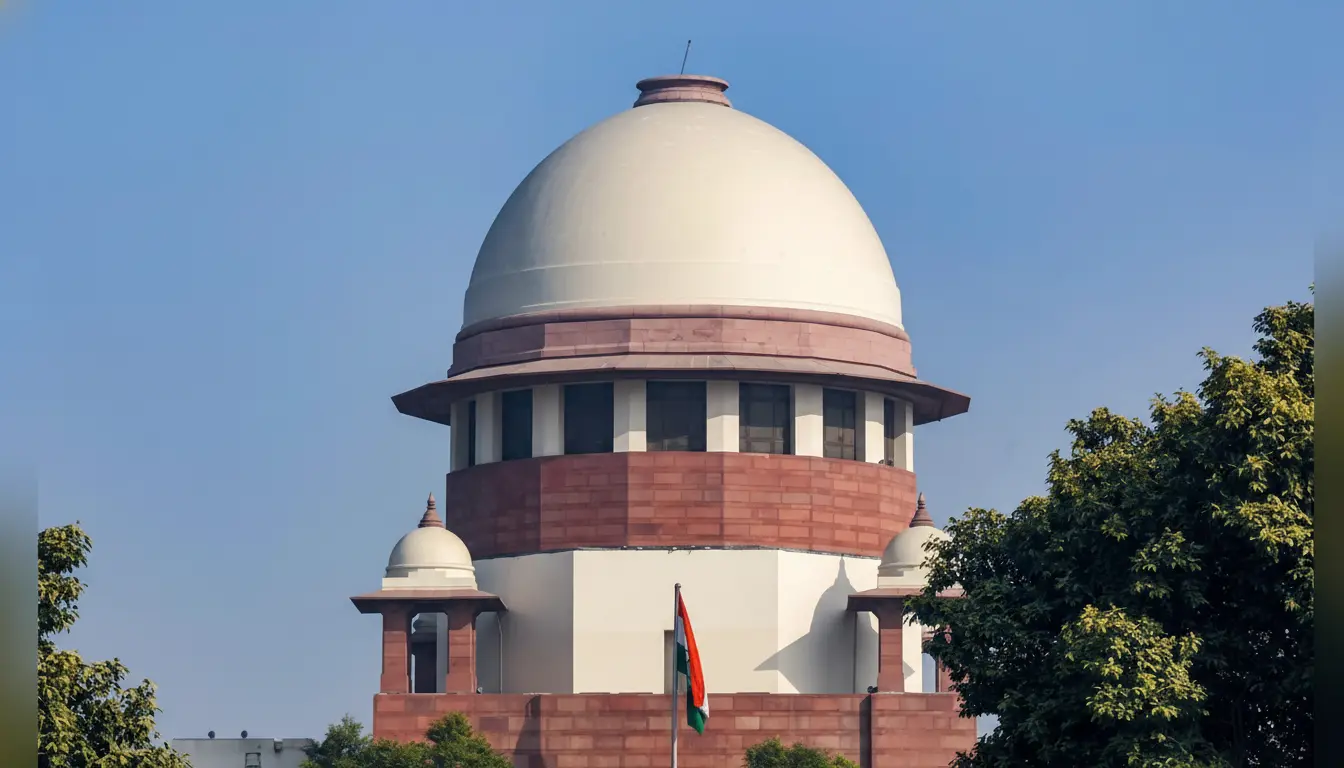
- The Supreme Court made an important observation on Monday, emphasizing that banks need to step up and create systems to alert customers about large transactions, especially after they’ve fallen victim to “digital arrest scams.” For instance, if a retiree typically withdraws amounts between 10,000 and 20,000, and suddenly starts making transactions of 25 lakhs or even 50 lakhs, the banks should definitely raise a red flag, the Court pointed out.
- A bench that included Chief Justice of India Surya Kant, Justice Joymalya Bagchi, and Justice NV Anjaria was reviewing a suo motu case regarding these digital arrest scams.
- During the proceedings, Attorney General for India R Venkataramani informed the Court that the Reserve Bank of India has put together a Standard Operating Procedure (SOP) for banks to handle such situations.
- This SOP includes measures that allow banks to place temporary debit holds to help prevent cyber fraud.
- The Court instructed the Ministry of Home Affairs to officially adopt this SOP and ensure it’s implemented nationwide.
The Supreme Court made an important observation on Monday, emphasizing that banks need to step up and create systems to alert customers about large transactions, especially after they’ve fallen victim to “digital arrest scams.”
For instance, if a retiree typically withdraws amounts between 10,000 and 20,000, and suddenly starts making transactions of 25 lakhs or even 50 lakhs, the banks should definitely raise a red flag, the Court pointed out.
A bench that included Chief Justice of India Surya Kant, Justice Joymalya Bagchi, and Justice NV Anjaria was reviewing a suo motu case regarding these digital arrest scams.
During the proceedings, Attorney General for India R Venkataramani informed the Court that the Reserve Bank of India has put together a Standard Operating Procedure (SOP) for banks to handle such situations. This SOP includes measures that allow banks to place temporary debit holds to help prevent cyber fraud. The Court instructed the Ministry of Home Affairs to officially adopt this SOP and ensure it’s implemented nationwide.
Senior Advocate NS Nappinai, who is serving as amicus curiae in this case, argued that banks should be required to alert customers about any suspicious transactions, suggesting that AI tools could be utilized for this purpose. She pointed out that simply issuing a circular from the RBI won’t be effective unless there are penalties for non-compliance.
The bench noted that banks need to take a more proactive approach in combating cyber fraud. The Chief Justice remarked, “If a business is handling crores in transactions, it might not raise any eyebrows. But when a pensioner, who usually withdraws 15,000-20,000, suddenly withdraws 50 lakhs, 70 lakhs, or even 1 crore, why didn’t your AI tools flag this as suspicious?” The Attorney General assured that the RBI would take this matter seriously.
We really hope you don’t take our directions the wrong way. If the RBI can set up some sort of mechanism…” the Chief Justice of India (CJI) remarked. He went on to emphasize that defining what constitutes suspicious transactions is crucial for banks to consider.
Justice Bagchi pointed out, “The issue is that banks are primarily focused on business, which is understandable. However, in doing so, they are inadvertently or perhaps intentionally becoming channels for the rapid and seamless transfer of stolen funds.” He highlighted that the Ministry of Home Affairs (MHA) report indicated that over Rs 52,000 crores have been misappropriated due to cyber fraud from April 2021 to November 2025.
CJI Kant noted that this staggering amount exceeds the budgets of many states. Justice Bagchi stressed that the RBI should incentivize banks to improve their reporting compliance.
“In their eagerness to make profits, banks must remember that they are custodians of public funds. People deposit their money because they trust these institutions. Unfortunately, these banks are turning into significant liabilities for the public. The courts are becoming their collection agents. They hand out loans without caution, and then we have the NCLAT just to help them recover their money!” the CJI stated.
Nappinai suggested that banks should face liability for negligence. She proposed that the RBI Ombudsman be empowered to handle complaints from fraud victims against banks.
Following the Supreme Court’s directive in the suo motu case regarding “digital arrest” scams, the Ministry of Home Affairs has set up a High-level Inter-Departmental Committee to thoroughly investigate all aspects related to “digital arrests.”
The Committee will operate under the leadership of the Special Secretary for Internal Security at the Ministry of Home Affairs (MHA). It includes members at the Joint Secretary level and above from various departments, such as the Ministry of Electronics and Information Technology (MeitY), the Department of Telecommunications (DoT), the Ministry of External Affairs (MEA), the Department of Financial Services, the Ministry of Law & Justice, the Ministry of Consumer Affairs, the Reserve Bank of India (RBI), the Central Bureau of Investigation (CBI), the National Investigation Agency, the Delhi Police, and the Indian Cyber Crime Coordination Centre (I4C).
According to a previous status report submitted by the MHA to the Supreme Court, the Committee held its first meeting on December 29. During this meeting, the CBI proposed establishing a monetary threshold for cases. Cases that exceed this threshold would be handled by the CBI, while those that fall below it could be managed by State or Union Territory agencies, with necessary support from the MHA.
On its end, the RBI has announced that it has issued an advisory to banks on using AI-based tools to detect fraud. Additionally, it is in the advanced stages of finalizing a Standard Operating Procedure for freezing bank accounts that are linked to suspicious transactions.