


- For the first time in more than two decades, the Reserve Bank of India (RBI) has opened the doors for credit cooperative societies to transform themselves into Urban Cooperative Banks (UCBs).
- However, it appears that the onus is on the heavyweights as the watchdog has laid stringent eligibility criteria for the applicants.
- Here is what the applicants need to know about the roadmap.
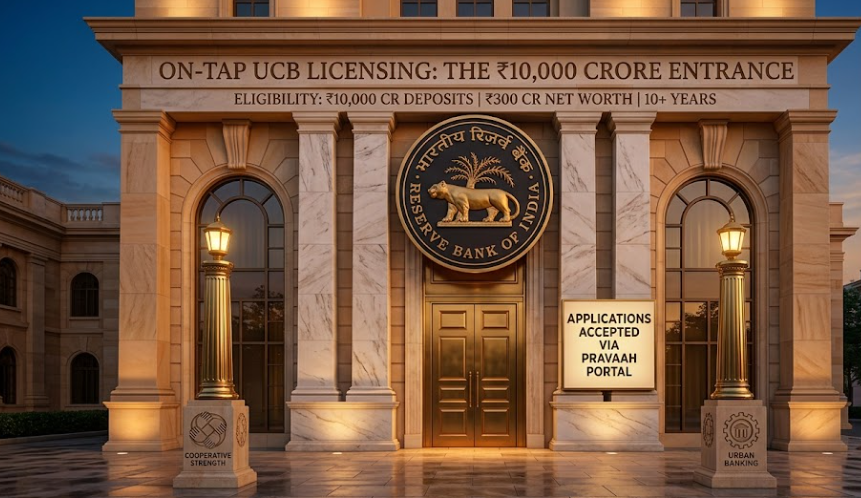
- Eligibility to Apply A credit cooperative society seeking to gain entry into the realm of Urban Cooperative Banks must possess a minimum of 10 years of experience.
- The entities must have a deposit base of Rs 10,000 crore and a net worth of Rs 300 crore.
For the first time in more than two decades, the Reserve Bank of India (RBI) has opened the doors for credit cooperative societies to transform themselves into Urban Cooperative Banks (UCBs). However, it appears that the onus is on the heavyweights as the watchdog has laid stringent eligibility criteria for the applicants.
Here is what the applicants need to know about the roadmap.
Eligibility to Apply
A credit cooperative society seeking to gain entry into the realm of Urban Cooperative Banks must possess a minimum of 10 years of experience. The entities must have a deposit base of Rs 10,000 crore and a net worth of Rs 300 crore. The RBI has made it clear that it will consider only those multi-state cooperative societies which operate with the presence in multiple states.
Sound Financials
In addition to the requirements mentioned earlier, the RBI is focusing on the financials of the prospective applicants. The entity must be financially stable and healthy with a record of five consecutive years of improving financial performance. An applicant must maintain a minimum Capital to Risk-Weighted Assets Ratio (CRAR) of 12 percent. At the same time, the Net NPAs should remain below 3 percent. In short, the financials of the applicant should not have any red flags.
Managing Directorships
The RBI is known to be extremely particular about the people it permits to manage the entities. As such, the RBI has mandated that a single individual cannot hold more than 5 percent of shares in the target entity. In addition, individual directors need to clear the Fitness and Powers test. Simply put, they need to have an impeccable track record and a clean slate regarding defaults.
18-Month Waiting Period
Unlike earlier practices, the RBI has turned the process to ‘on-tap’ licensing wherein credit cooperative societies do not have to wait for the RBI to notify the opening of slots. The applicants can directly apply via the PRAVAAH portal maintained by the RBI. The applicants will get an ‘in-principle’ nod from the regulator if their applications pass the scrutiny. Subsequently, the entity will get a period of 18 months to prepare itself for the transition by strengthening its IT infrastructure, cybersecurity mechanisms, and governance.

Not a Sure-Shot Deal
It must be noted that fulfilling the eligibility criteria does not guarantee licensing approval from the RBI. The apex bank has made it clear that banking is a high-leverage business, which involves a significant amount of risk. As such, the RBI will be selective with its approvals and will consider only the most viable applicants. Moreover, the RBI has also decided to put the ineligible applicants on a cooling-off period of three years before they can reapply.
In conclusion, we can say that India’s large credit cooperative societies have an incredible opportunity to join the league of traditional banks. However, they must first pass the RBI’s fitness test.